

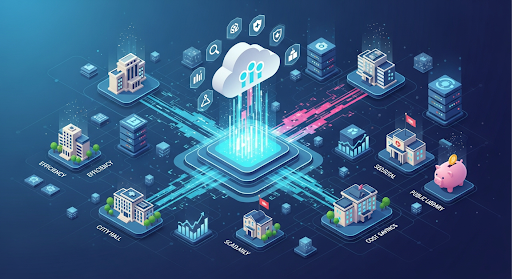
Cloud solutions have become a cornerstone of digital transformation for governments around the world. Rapid advances in technology, increasing citizen expectations, and the need for cost‑effective operational efficiency have pushed governments to rethink how they deliver public services. In this context, public sector cloud migration has emerged as a strategic imperative for modern governance. Coupled with initiatives such as the cloud‑first policy, public sector bodies are not just adopting cloud technology; they are transforming entire institutions from the inside out.
Why Cloud Solutions Matter for Government Operations
Traditionally, government IT systems relied on on‑premises servers and siloed applications that were expensive to maintain and difficult to scale. The rise of cloud computing offers an alternative: scalable resources, flexible deployment models, and improved accessibility. Through the public sector digital cloud shift, agencies can modernize legacy systems, streamline processes, and enhance service delivery to citizens.
This shift is especially evident in countries pursuing a cloud‑first policy Philippines, where government agencies are now required to consider cloud solutions before procuring traditional IT infrastructure. Such policies accelerate transformation by enabling shared services across departments, reducing duplication, and ensuring that public services are resilient, secure, and available 24/7.
Key Benefits of Public Sector Cloud Migration
1. Improved Efficiency and Cost Savings
One of the most tangible benefits of public sector cloud migration is cost reduction. Cloud platforms eliminate the need for expensive hardware refresh cycles and cut down on overhead for maintenance and facilities. Governments can pay only for what they use, making budget planning more predictable and freeing up resources for citizen‑facing services.
Moreover, cloud environments enable better collaboration across agencies. Departments that once operated in silos can now share data and applications securely, a critical enabler for integrated public services.
2. Enhanced Citizen Experience
Public expectations for fast, reliable online services continue to rise. Cloud solutions support modern digital interfaces, mobile access, and real‑time interactions, enabling government services that are responsive and efficient. Through public sector cloud migration, governments can deliver unified portals, mobile apps, and automated workflows that make it easier for citizens to interact with public services.
For example, digital ID systems, tax filings, and licensing portals hosted in the cloud can be available around the clock, ensuring that citizens can transact with the government on their terms.
3. Scalability and Resilience
Cloud environments provide elastic scalability, a game-changer for government agencies that face fluctuating demand. During peak times, such as tax season or emergency alerts, cloud systems can automatically allocate more resources without requiring manual intervention.
This scalability is critical not only for service continuity but also for resilience. Cloud providers invest heavily in security, redundancy, and disaster recovery, making cloud‑hosted government services more resilient to outages and cyber threats.
4. Agility and Innovation
Public sector organizations that embrace cloud technologies unlock a culture of innovation. The public sector digital cloud shift enables rapid prototyping, testing of new services, and integration of emerging technologies like artificial intelligence (AI) and data analytics. Instead of long procurement cycles and rigid infrastructures, agencies can adopt agile methodologies and bring new solutions to citizens faster.
This agility is at the heart of the cloud‑first policy Philippines, which encourages experimentation and rapid iteration of digital services.
5. Strengthened Data Security and Compliance
Security is paramount in government IT, and cloud providers offer state‑of‑the‑art protection through encrypted data storage, access controls, and continuous monitoring. With public sector cloud migration, governments can enforce uniform security policies across agencies and ensure compliance with national and international regulations.
Cloud infrastructure also enhances data governance. Rather than storing sensitive information in disparate local servers, governments can centralize control, audit access, and implement standard privacy protocols that protect citizens and the state alike.
Case Example: The Philippines and Cloud‑First Policy
The Philippines is a compelling example of how cloud initiatives can drive transformation in the public sector. Under a broader digital governance roadmap, the Philippine government has actively embraced cloud technologies through its cloud‑first policy. This policy mandates that government agencies consider cloud solutions as the default option when planning IT projects.
This strategic direction is aligned with major e‑governance initiatives that aim to unify public services, improve interoperability, and expand digital inclusion. As a result, more government services are accessible via online portals, mobile applications, and unified citizen platforms.
Public agencies are now leveraging cloud infrastructure not only for service delivery but also for data analytics, emergency response systems, and secure collaboration across departments. The shift to cloud has enabled the Philippines to respond more quickly to emerging needs, improve operational efficiency, and enhance public satisfaction with government services.
Cloud Solutions Driving Public Sector Transformation
From local governments to national agencies, the adoption of cloud solutions is reshaping how the public sector operates. Through public sector digital cloud shift, governments are breaking down legacy barriers, promoting digital inclusion, and delivering services that are efficient, secure, and citizen‑centric.
The cloud‑first policy Philippines exemplifies how a strategic, nation‑wide push toward cloud adoption can accelerate digital transformation. With cloud technologies at the core of public service delivery, governments are better equipped to face future challenges, leverage emerging technologies, and meet the evolving expectations of citizens.
As the global landscape of governance continues to evolve, it is clear that cloud solutions are not just an IT decision; they are a transformative force that drives operational excellence and public value.
Conclusion
Cloud technologies have fundamentally changed how public sector organizations operate. The benefits of public sector cloud migration, including efficiency, scalability, innovation, and security, make the transition imperative for any government aiming to deliver high‑quality, modern services. Similarly, a strategic cloud‑first policy can help ensure that digital solutions remain at the forefront of public service innovation.
GOVX.0 Philippines is the premier e‑governance summit uniting government leaders, policymakers, and tech innovators to accelerate digital transformation. With focused sessions on cloud strategies, interoperability, cybersecurity, and emerging technologies, GOVX.0 empowers public sector decision‑makers to unlock real solutions and drive large‑scale impact. Attend to connect with key stakeholders, explore cutting‑edge solutions, and lead your agency’s digital journey. Don’t miss this opportunity to shape the future of governance.